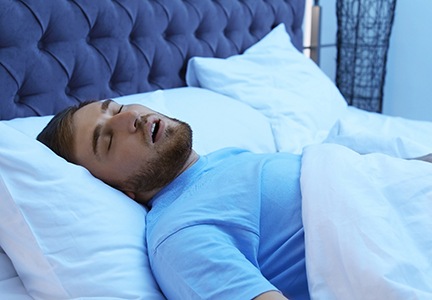
If you have sleep apnea, you might be keeping your partner up at night with loud snoring. Even worse, the disorder can make it nearly impossible to get a sufficient amount of quality sleep, leaving you feeling exhausted during your waking hours. Fortunately, with the right form of sleep apnea treatment in Greenfield, our dentists can help you get the problem under control and enjoy more restful nights again. Give Advanced Dental Treatment Center a call today to learn about the solutions we can offer for sleep-disordered breathing.
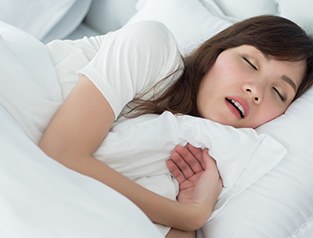
Sleep apnea is a sleep disorder that is estimated to affect tens of millions of Americans. When you have sleep apnea, your breathing frequently stops and restarts while you’re asleep. In many cases, the disorder is the result of the airway becoming obstructed due to the muscles in your throat collapsing.
Many people who suffer from sleep apnea don’t even realize that they have it. As such, it’s a good idea to familiarize yourself with the many potential warning signs of the disorder, including:
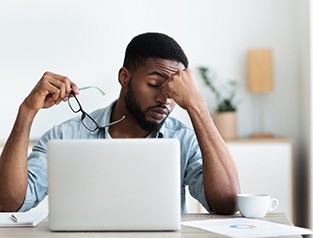
Whenever sleep apnea causes your breathing to stop, your brain briefly wakes you up in an effort to get some air. This disrupts the sleep cycle, thus depriving you of the quality rest your body needs. As a result, you’re likely to feel extremely drowsy during the day. Not only can this have a negative impact on the quality of your work, but it can also increase your risk of getting into an accident while driving.
Furthermore, if you don’t have sleep apnea treated in time, it could eventually lead to serious, potentially life-threatening health problems. Research shows that individuals with sleep apnea are much more likely to suffer from heart attacks and other cardiovascular issues.
Before you can have your sleep apnea treated, you will need to undergo a sleep test. A sleep expert can use the results of the test to determine whether you’re experiencing sleep-disordered breathing. For your convenience, we offer at-home sleep tests that can be used in the comfort of your own bed.
After a diagnosis has been made, you can start considering your options for treatment. If you would rather not use a noisy CPAP machine, you can talk to our team about getting a customized oral appliance. If you wear this device to bed, it will help keep your airway open by slightly repositioning your lower jaw and/or holding your tongue in place. Maintaining a clear airway can go a long way toward reducing your sleep apnea symptoms.
A pause in your breathing that lasts at least 10 seconds is considered a sleep apnea episode. Of course, some episodes are longer than others; in certain cases, it can take one or two minutes for breathing to resume.
It’s worth noting that the frequency of sleep apnea episodes can vary from case to case. Some patients may only experience 5 breathing interruptions in a single hour while others experience as many as 30 in the same time frame.
A sleep test can help determine how often your sleep apnea episodes occur and how long they last. This information is essential for determining the severity of your disorder and your best options for treatment.
Depending on the situation, you may be able to switch from CPAP treatment to oral appliance treatment. Many patients prefer oral appliances over CPAP machines since they don’t make noise and are often more comfortable.
That said, oral appliances work best for patients with mild to moderate sleep apnea; they often aren’t as effective for managing more severe cases of sleep-disordered breathing. Your sleep dentist will need to consider your situation carefully in order to determine whether transitioning to oral appliance treatment is a viable option in your case.
Obesity and sleep apnea often go hand in hand. If being overweight is contributing to your sleep-disordered breathing, then losing weight could go a long way toward helping you breathe easier at night. That said, it is not guaranteed that sleep apnea will go away after you’ve lost weight.
Even though loud snoring is a common symptom of sleep apnea, it doesn’t always mean that you have the disorder. The truth is that under the right circumstances, anyone can snore even if they don’t suffer from sleep-disordered breathing.
That said, there’s a good chance that snoring is related to sleep apnea if it’s accompanied by other warning signs, such as constantly feeling tired during the day or having trouble focusing. Of course, the only way to know for sure whether you have sleep apnea is to have a sleep test performed.
You can brush your oral appliance with a soft-bristled toothbrush. However, you shouldn’t use toothpaste for the cleaning process since it can damage the plastic; it’s better to use hand soap or another nonabrasive cleaning agent.
You should make a point of brushing your oral appliance every morning right after you take it out of your mouth. When you’re done cleaning the appliance, gently rinse it off before you put it back in its case.